NORTH CAROLINA - Long before the "First in Flight" license plates and the founding of the Roanoke Colony, the land of North Carolina was a diverse landscape of coastal sounds, rolling Piedmont hills, and some of the highest mountain peaks in the Eastern United States. Because the state’s borders were a later colonial invention, there was no single indigenous word for the entire region. Instead, the land was defined by three major linguistic groups: the Algonquian of the coast, the Siouan of the Piedmont, and the Iroquoian of the mountains and coastal plains.
The Coastal Plain: The Land of the Algonquian
The eastern coast of North Carolina, defined by the Outer Banks and vast sounds, was home to various Algonquian-speaking tribes.
- Croatan: This was both a tribe and the name of an island (now modern-day Hatteras). The name is believed to mean "Council Town" or "Talk Town."
- Roanoke: An Algonquian term meaning "Shell Money" or "White Beads" (wampum). The area was a significant hub for manufacturing the shell currency used throughout the Eastern Seaboard.
- Chowan: Derived from the word Chowanoke, meaning "People of the South."
- Secotan: One of the most famous coastal towns recorded by early explorers, meaning "Town at the Edge of the Woods."
The Piedmont: The Siouan Heartland
The central part of the state was the domain of various Siouan-speaking nations, including the Catawba, Saponi, and Tutelo.
- Catawba: As in South Carolina, the Catawba called themselves the Iye-Iswa-Hey, meaning "People of the River." They viewed the river systems as the central nervous system of their world.
- Woccocon: An early name for Ocracoke Island, likely derived from a Siouan term meaning "The Enclosure" or "Hooked Place."
- Occaneechi: Known as the "Great Traders" of the Piedmont, their name refers to "People of the Island," specifically their base on an island in the Roanoke River.
The Mountains: The Land of the Cherokee
The western mountains were—and still are—the ancestral home of the Cherokee (Ani-Yunwiya).
- Ani-Kituhi: The Cherokee often referred to themselves as the Ani-Kituhi, meaning "People of Kituwah." Kituwah is an ancient mound site in Swain County considered the "Mother Town" of the Cherokee, where their civilization began.
- Appalachian: While often used broadly, the name likely stems from the Apalachee nation. The Cherokee name for the mountains themselves often referred to them as the "Blue Mountains" or the "Great Smoky Mountains" (Shaconage), which translates to "Land of the Blue Smoke."
- Cullowhee: Derived from the Cherokee word gul-lo-hee, meaning "Place of the Lilies."
Living Etymology: North Carolina’s Indigenous Landmarks
The map of North Carolina is a living record of the first inhabitants and their descriptive markers of the environment:
- Neuse: Named for the Neusiok tribe; the name is believed to mean "Peace" or "Peaceful."
- Tar: While often associated with the state's naval stores history, some believe it stems from an indigenous word for "The River of Health."
- Nantahala: A Cherokee word meaning "Land of the Noonday Sun," referring to the deep gorges where the sun only hits the valley floor at midday.
- Uwharrie: Believed to be a Siouan word, possibly referring to a "River" or the rugged, ancient mountain range in the central part of the state.
- Pasquotank: An Algonquian term meaning "Where the Current Divides."
North Carolina’s indigenous legacy is one of Geographic Specialization. From the "Shell Money" makers of the coast to the "People of the Blue Smoke" in the west, the names left behind prove that the first inhabitants saw the state as a series of specialized zones—each with its own purpose, language, and sacred history.
What Native Americans Called North Carolina?
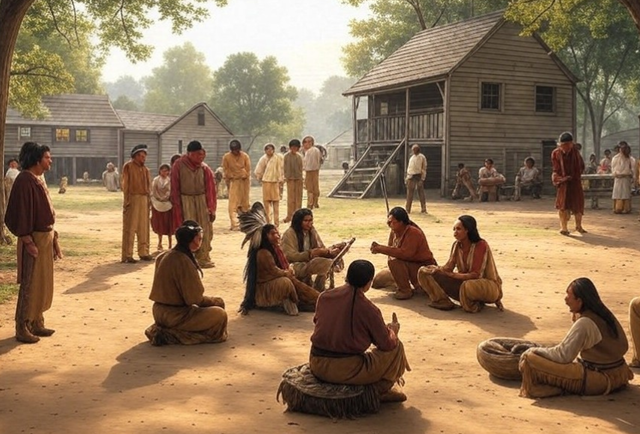
What Native Americans Called North Carolina?
Typography
- Smaller Small Medium Big Bigger
- Default Helvetica Segoe Georgia Times
- Reading Mode