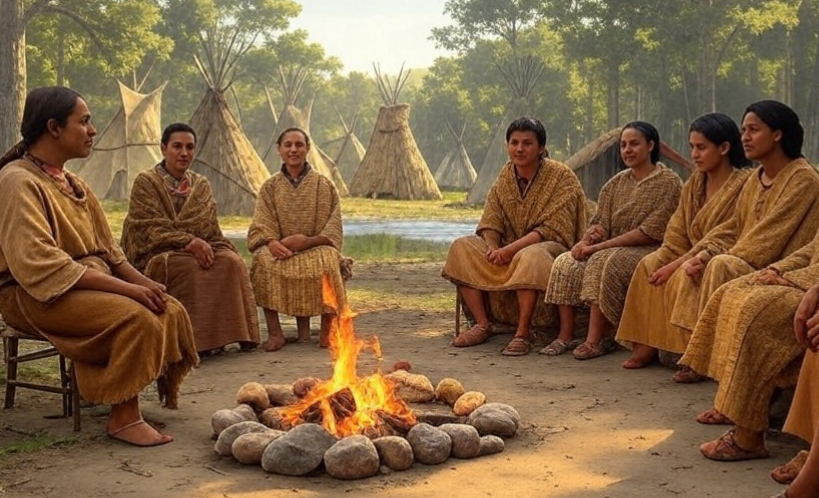
SOUTH CAROLINA - Long before the Palmetto State was a British colony, it was a complex landscape of fertile river valleys and coastal marshes inhabited by dozens of distinct nations. Because the borders of South Carolina were drawn by European cartographers, there was no single indigenous word for the entire state. Instead, the land was defined by the great river systems that sustained life—the Santee, the Pee Dee, and the Savannah—and the powerful nations like the Catawba and Cherokee who guarded them.
The Catawba: "People of the River"
The Piedmont region of South Carolina was the ancestral home of the Catawba Indian Nation. To them, the land was defined by the river that bore their name.
- Iswa: The Catawba called themselves the Iye-Iswa-Hey, meaning "People of the River." They viewed their territory not as a bounded state, but as the lifeblood flowing from the mountains to the coast.
- Catawba: While often used as the tribal name, some linguists believe it stems from a Choctaw word meaning "Divided" or "Separated," referring to their distinct language family in the region.
The Cherokee: "The Principle People"
The Upstate and Blue Ridge Mountains were the domain of the Cherokee, who called themselves the Ani-Yunwiya, or "The Principle People."
- Keowee: One of the most important Cherokee "Lower Towns" in South Carolina. The name translates to "Place of the Mulberries."
- Toxaway: A name that remains in the Upstate today, derived from a Cherokee word meaning "Place of the Bird."
- Jocassee: Traditionally translated as "Place of the Lost One," a name immortalized in local legends about the daughter of a tribal chief.
The Lowcountry and the Coast: "The Shellfish Gatherers"
The coastal plain was a mosaic of smaller tribes, often collectively referred to by the names of the rivers they lived along.
- Edisto: Named for the Edisto people, the word likely translates to "Black Water" or refers to the dark, tannin-rich waters of the coastal rivers.
- Kiawah: Named for the Kiawah people, who were part of the Cusabo confederacy. The name is believed to refer to the "Cusabo" (Coosaw) identity, meaning "River People."
- Wando: An indigenous term meaning "River of the Great Tree."
Living Etymology: South Carolina’s Indigenous Map
The map of South Carolina is a linguistic record of the "First People" and their descriptive markers of the terrain:
- Santee: Derived from the word Santi, meaning "The River" or "The People of the River."
- Pee Dee: Likely from a Catawba word meaning "Smart" or "Capable" people.
- Waccamaw: A tribal name believed to mean "The Shell" or "Place of Shells," reflecting the importance of the coast for gathering resources.
- Enoree: An indigenous term meaning "River of Muscadines" (wild grapes).
- Salkehatchie: Translates to "River of the Saltketchers" (a tribal group).
 South Carolina’s indigenous history is unique because of its River-Centric identity. Almost every major geographical name in the state—from the Ashepoo to the Wateree—is a reminder that for the first inhabitants, the land was not something to be fenced in, but a series of "Blue Highways" that dictated where they lived, traded, and survived.