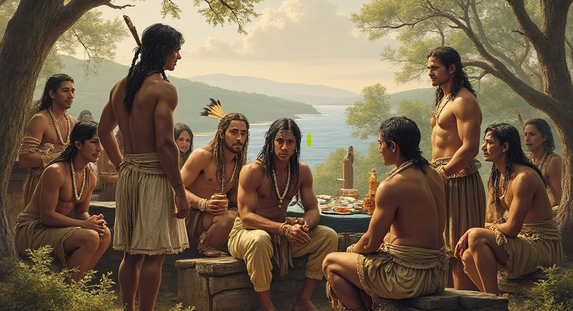
OHIO STATE - Like its neighboring states, the land we now know as Ohio was never defined by a single name or border by its original inhabitants. Instead, the "Ohio Country" was a vast, fertile territory shared and contested by multiple nations—including the Shawnee, Miami, Wyandot, Lenape, and Seneca. To these people, the land was a collection of sacred hunting grounds, river valleys, and ancestral earthworks that had been built by their predecessors over thousands of years.
Ohi:yo’: The Good River
 The name "Ohio" itself is a legacy of the Seneca (part of the Haudenosaunee or Iroquois Confederacy). It is derived from the word Ohi:yo’, which translates to "Good River" or "Great River." Interestingly, the Seneca didn't just use this name for the Ohio River as we know it today; they considered the Allegheny River in Pennsylvania and the Ohio River to be a single, continuous waterway. When French explorers arrived, they translated Ohi:yo’ into La Belle Rivière ("The Beautiful River").
The Shawnee: People of the South
The Shawnee were among the most prominent inhabitants of southern and central Ohio. They did not have a single word for the state, but their presence is etched into the map through the names of their political and social centers:
- Chillicothe: This was not just a city name; it was a Shawnee term (Chalakatha) for a "Principal Place" or capital. Whenever the tribe moved their headquarters, the new location became the new "Chillicothe."
- Piqua: Derived from Pekowi, the name of one of the five Shawnee divisions. According to legend, it means "A Man Coming Out of the Ashes."
- Scioto: From the Wyandot word skɛnǫ·tǫ’, meaning "Deer." The Scioto River valley was a primary hunting and agricultural hub for the Shawnee.
The Miami Valley and the North
In the western and northern reaches, the Miami and Wyandot nations shaped the terminology of the landscape:
- Maumee: This is a phonetic variation of the word "Miami." The Miami people called themselves the Myaamiaki ("Downstream People").
- Cuyahoga: A Mohawk word, Cayagaga, meaning "Crooked River." This perfectly described the winding path of the river in Northeast Ohio.
- Sandusky: Derived from the Wyandot word saandusti, meaning "Water Within Water-Pools" or simply "Cold Water."
The "Adena" and "Hopewell" Misnomer
Ohio is famous for its massive geometric earthworks and effigy mounds (like Serpent Mound). Modern archaeology refers to the builders as the "Adena" and "Hopewell" cultures. However, Native Americans often point out that these are exonyms—names given by white settlers based on the owners of the farms where the mounds were excavated.
The descendants of these ancient people, including the Shawnee and Miami, viewed these sites as sacred ancestral monuments, though their original names for these civilizations were lost during the massive migrations and displacements of the 17th century.
Living Etymology: Names You Know
Many of Ohio’s most familiar locations are descriptors of the physical land as seen through indigenous eyes:
- Ashtabula: From the Lenape Ashtepihəle, meaning "Always Enough Fish to Share."
- Coshocton: From the Lenape Koshaxkink, meaning "Where There is a River Crossing."
- Muskingum: From a Shawnee word meaning "A Town by the River" or "Swampy Ground."
- Wapakoneta: From the Shawnee Wa·po’kanite, meaning "Place of White Bones."
The map of Ohio remains a testament to a "Refuge Land." During the 1700s, tribes from the east—like the Lenape and Seneca—fled to the Ohio Country to escape colonial expansion, creating a rich, multi-ethnic indigenous landscape that defined the region until the forced removals of the 19th century.