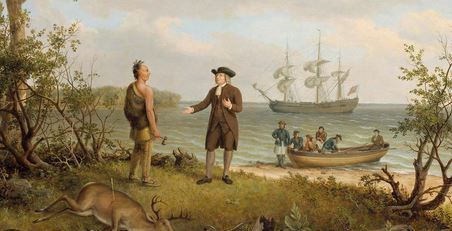
PENNSYLVANIA - Long before King Charles II granted a land charter to William Penn in 1681, the territory we now call Pennsylvania was a patchwork of distinct indigenous homelands. Because the modern borders of the "Commonwealth" are a colonial invention, there was no single Native American word for the entire state. Instead, the land was defined by the people who inhabited its diverse river valleys and mountain ridges.
Lenapehoking: The Land of the Lenape
The eastern third of Pennsylvania, encompassing the Delaware and Lehigh Valleys, was part of Lenapehoking. This term translates to "Land of the Lenape" or "Land of the Original People." For the Lenape (also known as the Delaware), the land was not a commodity to be owned, but a sacred space defined by its waterways. They did not see "Pennsylvania"; they saw a vast network of forests and rivers that sustained their villages.
- Coaquannock: This was the specific name for the area that is now Philadelphia. It translates to "The Grove of Tall Pines" or "Place of Tall Pines."
- Lenape Sipu: The name for the Delaware River, the lifeblood of their eastern territory.
- Manayunk: The original name for the Schuylkill River, meaning "Place to Drink."
The Susquehanna Valley: "People of the Muddy River"
Moving toward the center of the state, the land belonged to the Susquehannock (or Conestoga). While we use the name "Susquehanna" today, it is actually an exonym—a name given to them by their neighbors, the Lenape.
The word Sasquesahanough roughly translates to "People of the Muddy River." The Susquehannocks were a powerful Iroquoian-speaking confederacy that controlled the fur trade routes through the heart of Pennsylvania. Because their culture was decimated by disease and warfare by the late 1700s, many of their internal names for the landscape have been lost to time, surviving only through the names of the rivers they protected.
The Western Frontier: The Seneca and Shawnee
The western and northwestern portions of the state were the domain of the Haudenosaunee (Iroquois Confederacy), specifically the Seneca nation, and the Shawnee.
- O-he-yu: The Seneca name for the Allegheny River, which means "The Good River" or "Beautiful River." This is also the root of the name "Ohio."
- Kittatinny: A term used for the Blue Mountain ridge, meaning "The Endless Mountain."
- Wyoming: Derived from the Munsee Lenape word xwé:wamink, meaning "At the Great Plain."
Place-Names as Living History
 While the name "Pennsylvania" (meaning "Penn’s Woods") honors the English founder, the map of the state is still a ghost-map of indigenous history. The names we use every day are descriptive markers of how the first inhabitants viewed the terrain.
For example, Monongahela comes from Menaunangehilla, meaning "Falling-in Banks." Tioga stems from Te-yo-ga, meaning "At the Forks." Lycoming comes from Legaui-hanne, meaning "Sandy Creek," and Tunkhannock comes from Tánk-hanne, meaning "Small Stream."
Many of these names were "Anglicized" or "Latinized" by early explorers. The spellings we use today are often phonetic approximations of the original Unami or Munsee dialects, serving as a permanent record of the state's first inhabitants.