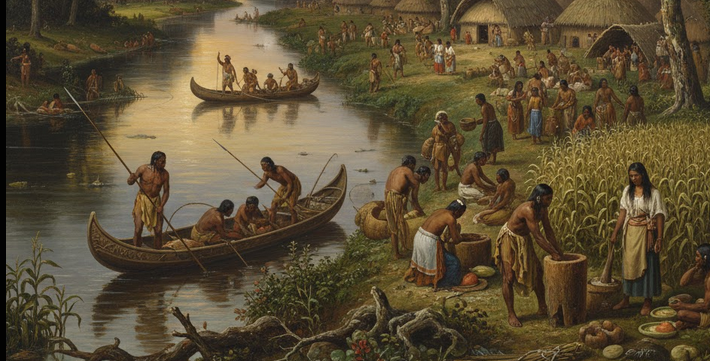
MARYLAND STATE - Long before the Charter of Maryland was signed in 1632, the Chesapeake Bay region was a densely populated network of indigenous nations. Because "Maryland" is a colonial name honoring Queen Henrietta Maria, there was no single Native American word for the entire state. Instead, the land was defined by the Chesapeake—the "Great Shellfish Bay"—and the diverse peoples who lived along its eastern and western shores.
The Chesapeake: "The Great Shellfish Bay"
The defining feature of Maryland’s geography is the Chesapeake Bay. The name itself is derived from the Algonquian word Chesepiooc, which most historians translate as "Great Shellfish Bay" or "At a Great River." For the indigenous people, the Bay wasn't just a body of water; it was a massive protein source and a liquid highway that connected dozens of distinct cultures.
The Western Shore: The Piscataway and Susquehannock
The western side of the Bay, including what is now the D.C. metro area, Baltimore, and Southern Maryland, was primarily the domain of the Piscataway Conoy and the Susquehannock.
- Piscataway: The name translates to "Where the Waters Blend," referring to the confluence of the Potomac and its tributaries. They were the most powerful confederacy in southern Maryland.
- Patawomeck (Potomac): This name, shared by the river and the people, translates to "Where Goods are Brought" or "Place of the Traders." It was a massive commercial hub for the region.
- Patapsco: The river that flows through Baltimore takes its name from the Algonquian word pota-p-sk-ut, meaning "Backwater" or "At the Rocky Point."
- Sasquesahanough (Susquehanna): As in Pennsylvania, this name means "People of the Muddy River." The Susquehannocks controlled the northern reaches of the state and were known for their formidable size and military strength.
The Eastern Shore: The Nanticoke and Pocomoke
The Eastern Shore was a distinct cultural landscape, home to the Nanticoke, the Choptank, and the Pocomoke people.
- Nanticoke: They called themselves the Nentego, which means "Tidewater People" or "People of the Tidewater." Their territory was a maze of marshes and rivers that provided a natural defense and an abundance of resources.
- Wicomico: This name stems from the words wicko (house) and mekee (building), likely meaning "A Place Where Houses are Built."
- Pocomoke: Translates to "Broken Ground" or "Pierced Ground," describing the unique topography of the southern Eastern Shore.
- Choptank: Meaning "A Stream that Separates," likely referring to the river's role as a boundary between tribal territories.
The Mountains: The Monacan and Shawnee
As you move into the panhandle and the Appalachian Highlands of Western Maryland, the Algonquian names of the coast give way to the influences of the Monacan and the migrating Shawnee.
- Antietam: Derived from an Algonquian word meaning "The Swift Water" or "The Swiftly Flowing Stream."
- Youghiogheny: A Lenape word meaning "A River Flowing in a Contrary Direction."
- Allegheny: Likely derived from the Lenape Oolikanna, meaning "The Best River."
Living Etymology: Maryland’s Indigenous Map
The names of Maryland’s counties, cities, and parks are a permanent record of the "First People" who managed this landscape for thousands of years:
- Wicomico County: Named for the "Place Where Houses are Built."
- Allegany County: Named for the "Beautiful River."
- Piscataway Park: Preserving the name of the "Waters Blend" people.
- Assateague: An Algonquian word meaning "Beyond the Opening" or "Marshy Island."
 Maryland's indigenous history is unique because of its high degree of maritime specialization. The names they left behind reflect a deep, scientific understanding of the tides, the "muddy" nature of the rivers, and the specific locations where "goods were brought" for trade.