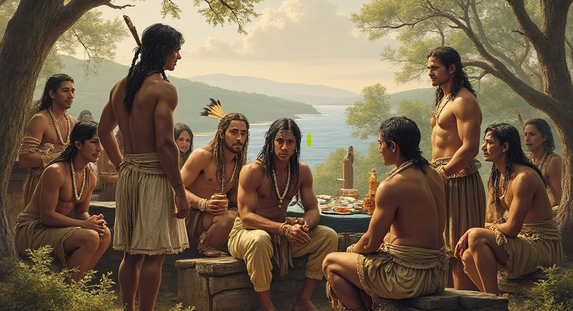
OHIO - The land that became Ohio was a crossroads of ancient civilizations and a vibrant territory for numerous Indigenous nations long before European settlement. Rich with fertile lands, abundant game, and crucial river systems connecting the Great Lakes to the Mississippi, Ohio was a coveted home and a strategic battleground.
Echoes in the Ohio Valley: The Native Peoples of Ohio
Today, due to centuries of displacement and conflict, there are no state or federally recognized Native American tribes located within Ohio's borders. However, the legacy of its first peoples is etched into the landscape and continues to be honored by descendant communities now living in other states.
The Hopewell & Adena Cultures (Ancient Builders)
Long before the historic tribes, Ohio was home to the ancient Adena (1000 BCE – 200 CE) and Hopewell (200 BCE – 500 CE) cultures. These societies were not "tribes" in the later European sense but complex, widespread societies known for their monumental earthworks.
- Mound Builders: They constructed massive ceremonial mounds, intricate geometric earthworks, and effigy mounds (like the Serpent Mound) that still stand today, demonstrating advanced astronomical knowledge and sophisticated social structures.
- Legacy: Their incredible archaeological sites, like those at Newark Earthworks and Fort Ancient, are among the most significant Indigenous heritage sites in North America.
Perhaps the most prominent and fiercely independent nation in historic Ohio, the Shawnee were a highly mobile Algonquian-speaking people who considered much of southern and central Ohio their primary hunting grounds and spiritual home.
-
Resistance Leaders: The Shawnee produced legendary leaders of resistance against American expansion, most notably Tecumseh and his brother Tenskwatawa (The Prophet). They formed a powerful pan-Indian confederacy that fought to preserve Native lands until the War of 1812.
The Wyandot (Huron)
An Iroquoian-speaking people, the Wyandot (often called Huron by the French) settled in northern Ohio after being displaced from their original homelands around Lake Huron.
-
Treaty Signers: The Wyandot were the last tribe to cede their lands in Ohio, doing so through the Treaty of Upper Sandusky in 1842, before being forcibly removed to Kansas and later Oklahoma.
The Miami
An Algonquian-speaking tribe, the Miami were influential in western Ohio, particularly along the Great Miami River.
-
Little Turtle: They rose to prominence under leaders like Little Turtle, who decisively defeated American forces in the Northwest Indian War before eventually negotiating peace through the Treaty of Greenville.
The Delaware (Lenape)
Though their traditional homeland was further east, many Lenape (or Delaware) migrated into eastern Ohio after being displaced from Pennsylvania and New Jersey.
-
Tragedy at Gnadenhutten: The peaceful Lenape village of Gnadenhutten was the site of a brutal massacre by American militia in 1782, a stark reminder of the violence and injustice of the frontier era.
A Crossroads of Conflict and Removal
The Ohio Valley became the central theater of the Northwest Indian War (1785-1795) and a key front in the War of 1812. Following the Battle of Fallen Timbers and the Treaty of Greenville, most Indigenous nations were gradually forced out of Ohio through a series of treaties and removals, primarily to Indian Territory (present-day Oklahoma) and Kansas.
Echoes in the Present
While no tribes remain in Ohio, their descendants actively preserve their heritage. The federally recognized Wyandotte Nation, Absentee Shawnee Tribe, Eastern Shawnee Tribe, Miami Tribe of Oklahoma, and Delaware Nation all trace their origins to Ohio.
 Ohio’s history is a testament to the resilience and deep cultural roots of these Indigenous nations, whose stories continue to be told at historical sites and museums across the state.