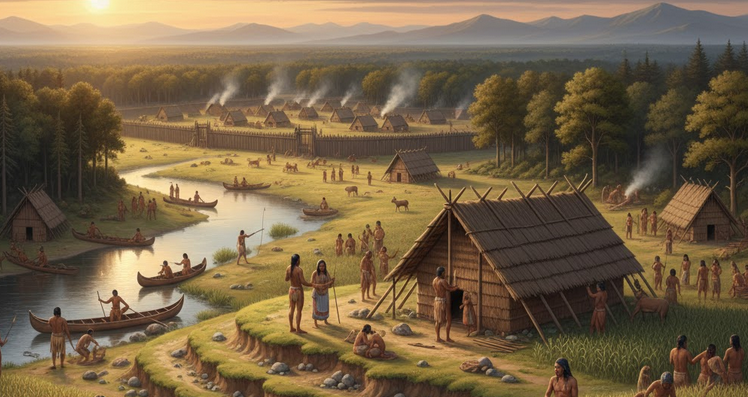
MARYLAND - Long before the founding of the Maryland Colony, the region between the Appalachian Mountains and the Atlantic Ocean was home to a diverse array of Indigenous nations. These tribes established sophisticated trade networks, maritime cultures, and political confederacies that shaped the Chesapeake Bay region for thousands of years.
Tidewater and Terrain: The Native Peoples of Maryland
Today, while Maryland has no federally recognized tribes, the state officially recognizes three tribal nations that remain active in their ancestral homelands.
The Piscataway (The People Where the Rivers Blend)
The Piscataway were once the most populous and powerful tribal nation in what is now southern Maryland. Their territory spanned the western shore of the Chesapeake Bay and the Potomac River valley.
- The Tayac’s Rule: Unlike many smaller independent bands, the Piscataway functioned as a sophisticated confederacy under a supreme leader known as the Tayac. They lived in large, fortified villages and were skilled farmers of corn, beans, and squash.
- Modern Recognition: Today, the community is represented by two state-recognized groups: the Piscataway Conoy Tribe and the Piscataway Indian Nation. They are headquartered in southern Maryland and continue to host cultural events and advocate for environmental protection of the Potomac.
The Nanticoke (The Tidewater People)
Occupying the Eastern Shore, the Nanticoke were famous for their mastery of the water. Their name literally translates to "People of the Tidewater."
- Master Merchants: When Captain John Smith explored the Chesapeake in 1608, he described the Nanticoke as the most skilled merchants in the region. They were renowned for producing high-quality wampum (shell beads) used for trade across the Northeast.
- Survival and Migration: During the 1700s, many Nanticoke were forced to migrate north to join the Iroquois Confederacy, but a resilient community remained in the Delmarva region. Today, the Nanticoke Indian Association (based in nearby Millsboro, DE) serves many descendants across the Maryland border.
The Accohannock
The Accohannock are a smaller tribe with ancestral roots on the lower Eastern Shore, specifically in Somerset County.
- Agricultural Roots: Historically, the Accohannock were a sub-tribe of the Powhatan Confederacy. They were primarily hunter-gatherers and farmers who utilized the rich marshes of the Chesapeake for food and medicine.
- Current Status: The Accohannock Indian Tribe is the third state-recognized group in Maryland. They are dedicated to preserving their language and maintaining a tribal farm and museum in Marion Station.
The "Reservation" in Baltimore: The Lumbee Migration
In a unique chapter of Maryland history, the largest Indigenous population in the state today belongs to a tribe not originally native to Maryland: the Lumbee.
- The Great Migration: Following World War II, thousands of Lumbee Indians migrated from North Carolina to East Baltimore in search of industrial jobs.
- A Vibrant Hub: The community in Upper Fells Point became so concentrated that it was affectionately known as "The Reservation." Today, the Baltimore American Indian Center serves as a vital cultural hub for the Lumbee and other "urban Indians" living in the city.
A Legacy Reclaimed
 In 2012, Maryland formally recognized the Piscataway nations, followed by the Accohannock in 2017. These acts were more than symbolic; they restored a sense of legal and cultural identity to thousands of Marylanders who had been "hidden in plain sight" for generations.