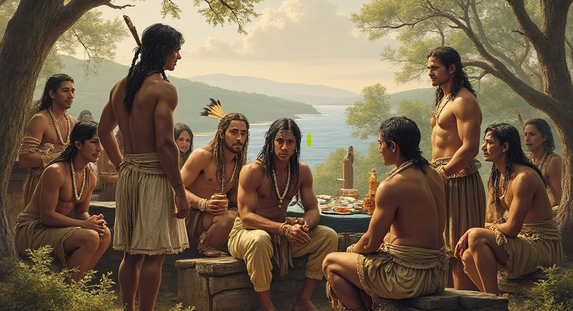
NEW YORK - The state of New York is primarily defined by the powerful, enduring history of the Haudenosaunee Confederacy (known to the French as the Iroquois and to the English as the Five, and later Six, Nations). While other nations held territory, the Haudenosaunee were the dominant political and military force in the region for centuries.
The Indigenous history of New York is unique for its early establishment of sophisticated inter-tribal governance and the continued, unbroken presence of its sovereign nations today.
The Haudenosaunee Confederacy (The Six Nations)
The name Haudenosaunee translates to "People of the Longhouse." Their Confederacy, established centuries before European contact, is a sophisticated democratic government and kinship system that bound together six distinct nations. Their ancestral homelands stretch across much of central and upstate New York, often referred to as the Iroquois Homeland.
The Six Nations (listed alphabetically) are:
- Cayuga
- Mohawk
- Oneida
- Onondaga (The central "Fire Keepers" and traditional capital of the Confederacy)
- Seneca
- Tuscarora (Joined the Confederacy in the early 18th century after migrating from North Carolina)
Key Cultural Features
- Political Structure: The Confederacy is governed by the Great Law of Peace (Gayanashagowa), a constitution that predates modern Western democracies. It is structured around a Grand Council of Chiefs (Sachems) appointed by the clan mothers of each nation.
- Matrilineal Society: The Haudenosaunee society is strongly matrilineal and matrilocal. Women, particularly the Clan Mothers, held significant political and spiritual authority, controlling property and having the power to select and depose male chiefs.
- The Longhouse: Families lived communally in long, multi-family longhouses (yehakins), which symbolize the Confederacy itself—a single, shared home extending across the territories of all six nations.
Other Significant Nations
While the Haudenosaunee were dominant inland, other important Algonquian nations occupied the coastal and riverine areas.
- Lenape (Delaware): Bands of the Lenape Nation inhabited the lower Hudson River Valley and Long Island (often referred to as the Munsee dialect group, or Esopus). They were the first to interact extensively with the Dutch settlers.
- Mahican (Mohican): This Algonquian nation controlled territory along the upper Hudson River Valley, extending into western New England. They were historically rivals of the Mohawk.
- Wappinger: Various Algonquian groups who lived along the eastern side of the Hudson River.
The Legacy of Sovereignty
The history of the Haudenosaunee is marked by their diplomatic prowess and military strength, which allowed them to maintain sovereignty and control over vast territories throughout the colonial era. They played a decisive role as a political entity in the French and Indian War and the American Revolution, though the Confederacy itself was tragically split during the latter conflict.
Today, New York is home to 10 federally recognized reservations belonging to the Haudenosaunee nations and their neighbors, representing some of the most stable and enduring sovereign Native governments in the country.
Federally Recognized Sovereign Nations in New York:
- Cayuga Nation
- Mohawk Tribe (St. Regis Mohawk Tribe)
- Oneida Nation
- Onondaga Nation
- Seneca Nation of Indians
- Tonawanda Band of Seneca
- Tuscarora Nation
- Shinnecock Indian Nation (Algonquian, Long Island)
- Poospatuck/Unkechaug Nation (Algonquian, Long Island)
 The Haudenosaunee nations remain politically and culturally active, preserving their language and governance structure and ensuring that the legacy of the Longhouse continues to define the history of New York State.