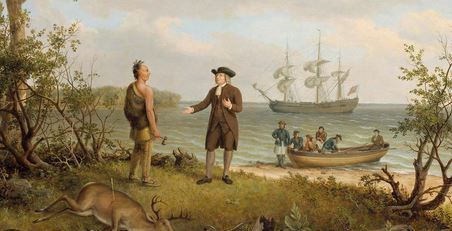
PENNSYLVANIA STATE - Pennsylvania, synonymous with the birth of the United States, boasts a rich history that extends back to its earliest colonial settlements. Before sprawling cities and modern infrastructure, the foundation of Pennsylvania was laid with the establishing of its first counties in 1682. These original counties – Bucks, Chester, and Philadelphia – represent the beginnings of Pennsylvania's organized governance and offer a glimpse into the lives of the state's earliest European settlers.
Pennsylvania's Founding Counties: Exploring the Historic Roots of Bucks, Chester, and Philadelphia
This article delves into the history of these three foundational countries, exploring their origins, namesake, and enduring significance.
The Genesis of Governance: Pennsylvania's Original Three Counties
The year 1682 marks a pivotal moment in American colonial history. In this year, William Penn, granted the vast territory that would become Pennsylvania, took the crucial first step in organizing his new venture by establishing the commonwealth's administrative framework. This process resulted in the formation of the three original counties: Bucks, Chester, and Philadelphia.
1682: A Triad of Counties Takes Shape
In a move essential for establishing a functioning system of governance and order, William Penn officially established the three original counties in 1682. This act of creating counties was one of the first steps in organizing his new colony and setting up a system of government, including courts and local administration, as meticulously documented in the Pennsylvania State Archives and historical records of early Pennsylvania. These counties encompassed the southeastern portion of present-day Pennsylvania, forming the area of initial English settlement along the Delaware River. This initial structure provided the governmental foundation for Penn’s ambitious vision.
Bucks County: A Nod to Penn's English Heritage
Located immediately to the north of what would become the City of Philadelphia, Bucks County was named by William Penn as a tribute to his family's roots. It was named after Buckinghamshire, England, the home county of the Penn family, a common practice used to provide familiar context for colonial settlements, as noted in various histories of Bucks County and biographies of William Penn.
Bucks County quickly emerged as a center of productive agricultural activity, fueled by the fertile land of the Delaware Valley. The area became known for its strong Quaker settlement, which played a major role in the local economy and culture. Furthermore, early relations with the resident Lenape Native Americans were characterized by relatively peaceful coexistence and mutual trade, reflecting Penn’s "Holy Experiment" philosophy (at least initially).
Chester County: From Oldest City to Sprawling Farmland
Situated to the west of Philadelphia, Chester County carried a unique historical distinction. The settlement of Chester, which was initially contained within the vast boundaries of Chester County (and now resides in present-day Delaware County), holds the honor of being the oldest European settlement in Pennsylvania, predating the county's official founding in 1682. The initial boundaries of Chester County were immense, stretching far westward toward the unmapped frontier.
The county quickly became renowned for its undulating topography, rolling hills, and extraordinarily fertile farmland. Its settlement drew a diverse population, including Quakers, numerous Welsh settlers (who established the "Welsh Tract"), and other groups. These communities fostered an early spirit of industry and agriculture that defined the region for centuries.
Philadelphia County: The Heart of Colonial Pennsylvania
Philadelphia County, encompassing the city William Penn famously laid out, was unequivocally the political, economic, and cultural heart of colonial Pennsylvania. The city of Philadelphia served as the capital of the colony from 1683 until 1799. Furthermore, due to its central importance and strategic location, it functioned as the capital of the United States during much of the Revolutionary War and in the early years of the republic (1790–1800), making it a principal focal point of American history, as detailed in various histories of Philadelphia and the records of the U.S. National Archives. The county was the personal residence of William Penn. In 1854, the city and county of Philadelphia were consolidated into one entity, meaning the boundaries are currently coterminous. The dense population and concentrated commerce of Philadelphia County necessitated immediate and robust municipal governance.
Evolution and Legacy
The original territorial integrity of Bucks, Chester, and Philadelphia counties did not last forever. Over time, as Pennsylvania's population swelled and expanded westward, their immense boundaries were altered, and numerous new counties were created from their original territories. For instance, parts of Chester County were eventually used to create Lancaster, Berks, and, most directly, Delaware County.
Despite these divisions, Bucks, Chester, and Philadelphia counties retain their immense historical significance. They represent the earliest centers of European settlement, the vital development of colonial government, and the foundation upon which Pennsylvania was ultimately built, creating a legacy of diverse cultural heritage and civic life that continues to shape the state today.
 Bucks, Chester, and Philadelphia counties, established in 1682, represent the very beginnings of Pennsylvania's organized existence. They are more than just administrative divisions; they are links to the state's colonial past, reflecting the vision of William Penn, the lives of early settlers, and the foundations of Pennsylvania's growth and development. Exploring these counties today – visiting their historic sites, strolling through their charming towns, and learning about their unique histories – offers a journey back in time to the very roots of the Keystone State.
Share This Article on Social Media
Sources:
- Pennsylvania State Archives
- Historical records of early Pennsylvania
- Bucks County Historical Society
- Chester County Historical Society
- Historical Society of Pennsylvania (Philadelphia)
- Biographies of William Penn
- Histories of Philadelphia, Bucks County, and Chester County