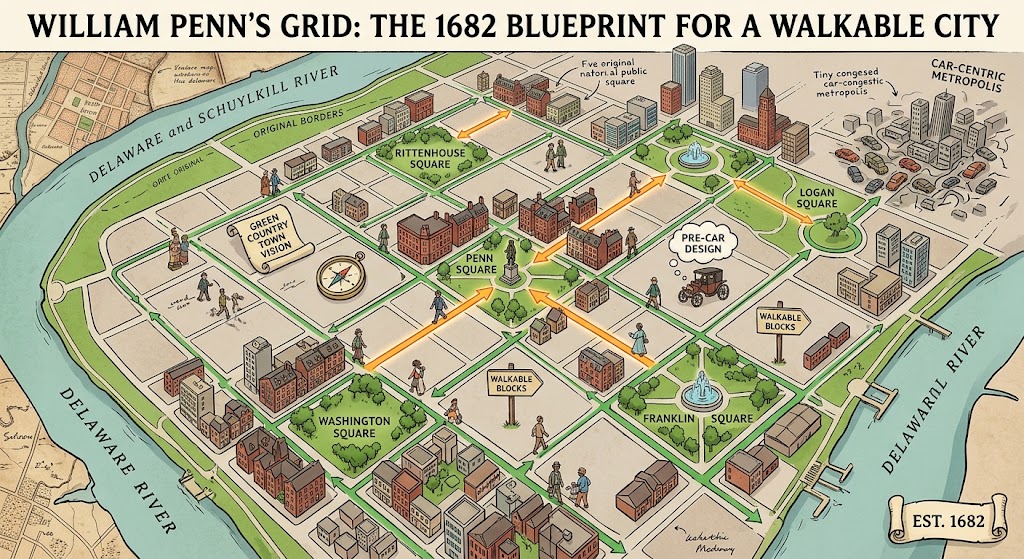
PENNSYLVANIA - Walking through Center City Philadelphia, you feel a distinct rhythm and scale that feels fundamentally different from the sprawling, car-centric landscapes of newer American cities or the towering concrete canyons of New York. This unique, intimate atmosphere is not an architectural accident. It is the direct, lasting result of a 17th-century utopian vision that successfully shaped a 21st-century metropolis.
In 1682, founder William Penn laid out his detailed blueprint for a "green country town." Long before the invention of the automobile, Penn designed a city explicitly meant to be navigable, healthy, and scaled to the human experience.
The "Green Country Town" Vision
Penn had witnessed the devastating effects of the bubonic plague and the Great Fire of London, both exacerbated by cramped, chaotic, and heavily congested medieval streets. To avoid these urban pitfalls in his new colony, his blueprint prioritized space, order, and nature.
- The Five Squares: Penn anchored his grid with five dedicated public green spaces (now known as City Hall/Penn Square, Rittenhouse, Washington, Logan, and Franklin squares). This ensured that all residents had immediate access to nature.
- Breathing Room: He originally intended for homes to be built in the center of spacious lots, leaving ample room for gardens, orchards, and fresh air, creating a literal "green" town.
The Original Grid System
Philadelphia is widely credited as the first planned city in the United States to utilize a strict grid system. Because it was designed for pedestrians and horses, the city's foundational scale remains remarkably accessible today.
- Navigable Blocks: The straight, easy-to-read grid system of intersecting parallel and perpendicular streets made navigation incredibly intuitive, setting a gold standard later adopted by cities across the country.
- Intimate Scale: The relatively narrow width of the historical streets naturally slows down modern vehicular traffic, inadvertently maintaining a safer, more comfortable environment for today's pedestrians and cyclists.
A Blueprint for Modern Living
Today, the legacy of Penn's grid is a highly walkable, deeply connected urban environment. The easy, straight-line strolls between historic public squares foster a tight-knit, village-like community feel within a massive city. While dense rows of brick have long replaced the original sprawling orchards, the original 1682 intention—a city built fundamentally for the well-being, interaction, and mobility of its residents—remains vividly alive in the fabric of modern Philadelphia.
 Share This Article on Social Media
How does the walkability of Philadelphia's historic grid influence the specific neighborhoods you choose to spend time in?