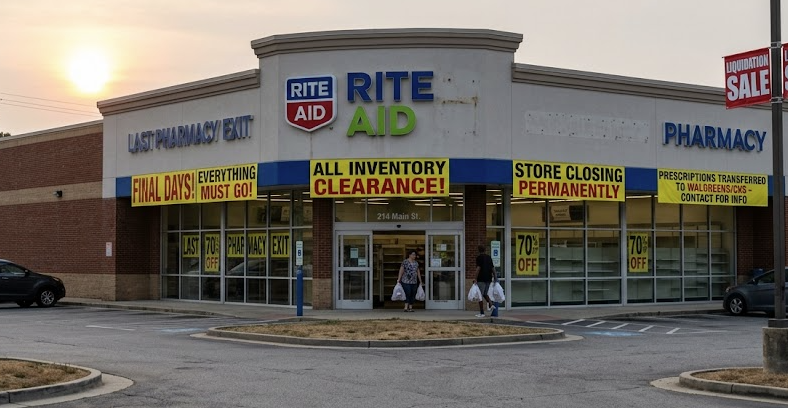
WEST VIRGINIA - The Mountain State is witnessing the end of an era this June as Rite Aid completes its total liquidation, marking the permanent closure of every remaining location across West Virginia. After serving as a cornerstone of both urban and rural communities for decades, the pharmacy giant is finalizing its exit following a second Chapter 11 bankruptcy filing that failed to secure a buyer for its brick-and-mortar storefronts.
A State-Wide Contraction
While West Virginia has already seen waves of closures over the past two years, this final phase represents a total withdrawal. By mid-June 2026, the last of the blue-and-red signs will go dark. The process is moving rapidly across the state:
- Final Inventory Sales: Shoppers in remaining hubs are seeing discounts of up to 70-90% on non-prescription goods as stores enter their final "liquidation only" phase.
- Property Vacancies: From the busy corridors of Charleston and Huntington to community centers in the Potomac Highlands, Rite Aid's exit leaves behind large, specialized real estate footprints that may prove difficult to fill in a changing retail economy.
- Prescription Record Transfers: To ensure patient safety, Rite Aid has coordinated the bulk transfer of patient files. Most West Virginia records have been migrated to Walgreens or CVS, though some rural patients are being directed to local independent pharmacies.
The "Chapter 22" Fallout
The total exit follows what industry analysts have dubbed a "Chapter 22"—a second bankruptcy filing (the first occurring in late 2023 and the second in May 2025). Despite emerging briefly as a private company in 2024, the chain could not overcome the mounting pressure of opioid-related litigation settlements and a multi-billion-dollar debt load.
When a final "Section 363" sale failed to secure a bidder willing to keep the physical stores operational, the court-ordered liquidation became the only path forward.
Impact on Rural Healthcare
The loss of Rite Aid is particularly significant for West Virginia's rural population. In many counties, the local Rite Aid was more than just a place to pick up medication; it was a primary healthcare touchpoint and a source of essential household goods.
"In many of our smaller towns, Rite Aid was the anchor," says local economic analyst Sarah Miller. "Its departure doesn't just leave a hole in the storefront—it creates a 'pharmacy desert' that forces elderly patients to drive much further for basic care."
What Patients Need to Know
For those still managing health needs during this final transition:
- Check Your Labels: Most recent prescription bottles will now list the name of the receiving pharmacy (e.g., Walgreens) if the transfer has already occurred.
- Digital Access: Patients can still access their historical vaccination and pharmacy records via the Rite Aid Digital Portal until the company's final dissolution later this summer.
- Controlled Substances: Note that Schedule II prescriptions generally do not transfer automatically and will require a fresh script from a physician for the new pharmacy.
- As the final inventories are cleared by mid-month, West Virginians are saying a quiet goodbye to a retail icon that has been a fixture of the State commercial landscape for generations.