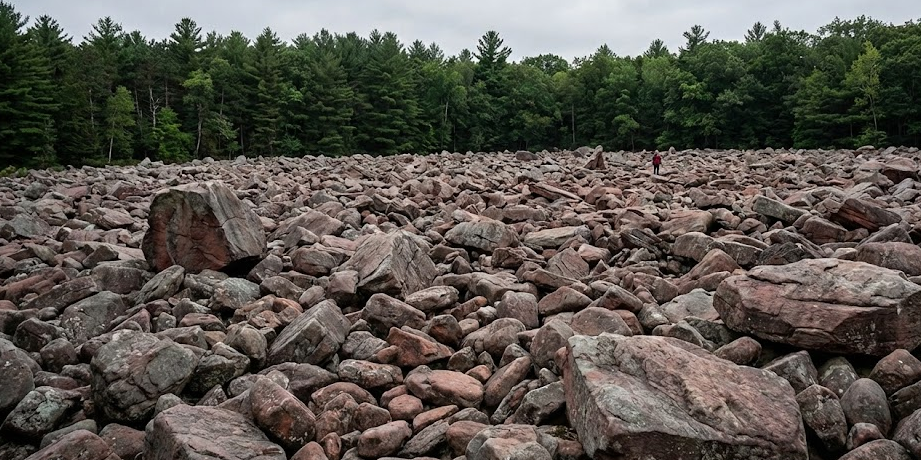
PENNSYLVANIA - Deep in the heart of the Poconos, surrounded by dense green forests and rhododendron thickets, there is a glitch in the landscape. Drive down a gravel road in Hickory Run State Park, and the lush Pennsylvania wilderness abruptly vanishes. In its place is a stark, barren expanse that looks less like Earth and more like the surface of Mars.
This is the Boulder Field: a massive, 16-acre expanse of jumbled red sandstone that has baffled visitors and fascinated geologists for over a century. It is a place where trees refuse to grow, where the ground is treacherous to walk on, and where the landscape has remained virtually unchanged since the end of the last Ice Age.
A Geological Anomaly
The statistics of the Boulder Field are staggering.
It measures roughly 400 feet wide and 1,800 feet long. The depth of the rock pile varies, but in some places, the boulders are stacked 12 feet deep. The rocks themselves range from mere pebbles to massive monoliths 25 feet in length.
But the most striking feature is what is missing: soil.
Because there is almost no dirt between the rocks, very little vegetation can grow here. It is a vast, gray-and-red desert in the middle of a temperate rainforest. Geologists call this formation a felsenmeer, a German word that literally translates to "sea of rocks."
While smaller examples exist elsewhere in the Appalachians, the Hickory Run Boulder Field is widely considered the largest and finest example of its kind in the eastern United States.
The Ice Age Connection
How did millions of massive rocks end up piled in one relatively flat spot? For years, locals theorized it was everything from a dried-up riverbed to the site of a massive prehistoric explosion.
The truth, however, is colder and much slower. The Boulder Field is a direct remnant of the Wisconsin Glaciation, the last major Ice Age that peaked roughly 20,000 years ago.
During this time, a massive continental ice sheet covered much of North America. The southern edge of that ice sheet stopped just a few miles north of where the Boulder Field sits today.
This area wasn't covered by the glacier, but it was a frozen, tundra-like environment sitting right next to it. The climate was violently cold.
The "Freeze-Thaw" Engine
The Boulder Field was formed by a process called "frost wedging," essentially a super-charged version of how potholes form on highways today.
- Water from rain and melting snow seeped into small cracks in the solid sandstone bedrock.
- When temperatures dropped, that water froze and expanded, forcing the cracks wider.
- Over thousands of years of this relentless freeze-thaw cycle, the bedrock was shattered into millions of individual boulders.
Because the terrain here is relatively flat (about a 1% slope), gravity didn't pull the rocks down a mountainside. Instead, they just accumulated in place, churning and grinding against each other as the ground froze and thawed, creating the jumbled, chaotic puzzle we see today.
A Window Into Prehistory
Perhaps the most amazing aspect of the Boulder Field is that when you look at it today, you are seeing the world exactly as it looked 15,000 years ago.
When the climate warmed and the glaciers retreated north, forests recolonized most of Pennsylvania. But they couldn't conquer the Boulder Field. The rocks are piled so deeply that trees cannot take root to begin the slow process of turning stone into soil.
It is a landscape frozen in time—a National Natural Landmark that offers a rare glimpse into Pennsylvania’s frigid, prehistoric past.
Visiting the Field
Unlike many geological wonders that require strenuous hikes, the Boulder Field is surprisingly accessible. A rustic road within Hickory Run State Park leads directly to the edge of the field.
Visitors are permitted to walk out onto the rocks, though extreme caution is required. The boulders are often loose and can shift underfoot. Hopping from rock to rock creates a distinct, metallic "clanking" sound that echoes across the clearing.
In the summer, the open expanse of rock absorbs heat, making the field significantly hotter than the surrounding forest, adding to the feeling that you have stepped onto an alien world.