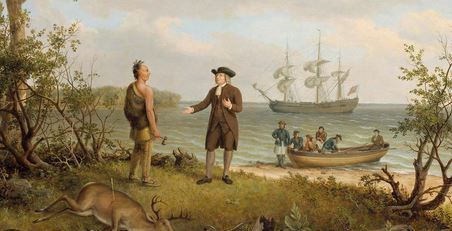
OHIO - The name "Ohio" is an English adaptation of the Seneca (Iroquoian) word Ohi: yo', which translates to "Good River" or "Beautiful River." While the state is now an industrial and agricultural powerhouse, its ancient identity was that of a lush, wooded heartland where the great river systems served as the primary veins of travel and trade.
Before it was the "Buckeye State," the region was a vital domain for the Shawnee, Miami (Myaamia), Wyandot, and Lenape (Delaware).
A Crossroads of the Great Trails
Ohio's geography—situated between the Great Lakes and the Ohio River valley—made it one of the most significant strategic regions in North America. It was crisscrossed by ancient paths like the Great Trail, which connected the forks of the Ohio to the shores of Lake Erie:
- The Shawnee: Known as the "Southerners," the Shawnee were a powerful, nomadic nation. They established major towns like Chillicothe (meaning "Principal Town") and Piqua. They were fierce protectors of the Ohio Valley, led by legendary figures such as Tecumseh and Blue Jacket.
- The Myaamia (Miami): The Miami held the western part of the state, particularly the river valleys that still bear their name. Their name translates to "Downstream People," and they were the gatekeepers of the vital portages between the river systems of the north and south.
- The Wyandot: Descendants of the Wendat (Huron), the Wyandot inhabited northern Ohio around the Sandusky region. They were respected as the "Uncle" of the other tribes in the region, often serving as the keepers of the council fires for the Ohio confederacies.
- The Lenape (Delaware): After being pushed from their eastern coastal homelands, the Lenape established new towns along the Muskingum and Tuscarawas rivers, where they sought to rebuild their society in the "Western Country."
Regional and Cultural Designations
Indigenous terminology defines the natural landmarks that gave Ohio its character:
- Ohi: yo' (The Ohio River): To the Seneca and other Iroquoian peoples, this was the "Great" or "Beautiful" river. To the Shawnee, it was a life-giving highway that connected their far-flung villages.
- The Great Black Swamp: In the northwest, this massive wetland (now largely drained) was a sanctuary for the Wyandot and Ottawa, providing protection and a unique ecosystem of cedar and ash forests.
- The Scioto and Muskingum Valleys: These were the agricultural centers of the Ohio world, where the Shawnee and Delaware maintained vast fields of corn, beans, and squash.
Significant Indigenous Place Names
The map of Ohio is a living archive of the Shawnee, Miami, and Lenape languages. Ashtabula comes from a Lenape word meaning "Always enough fish to share." Cuyahoga is an Iroquoian word for "Crooked River."
The city of Wapakoneta is a Shawnee word meaning "Place of White Bones." Coshocton is a Lenape word meaning "Union of Waters," marking the confluence of the Walhonding and Tuscarawas rivers. Olentangy refers to the "River of Red Paint," and Wauseon honors a Potawatomi leader. Even the name Sandusky is believed to be derived from a Wyandot word meaning "Water" or "At the Cold Water."
A Living Sovereign Presence
While most Ohio tribes were forcibly removed to Oklahoma and Kansas in the 1830s, their connection to the "Beautiful River" remains strong. Today, the Miami Tribe of Oklahoma, the Shawnee Tribe, and the Wyandotte Nation continue to consult on the preservation of ancient sites such as Serpent Mound and the Newark Earthworks, built by the ancestors of modern Indigenous peoples.
By recognizing the legacy of Ohi: yo' and the "Principal Towns" of the Shawnee, we acknowledge that Ohio's identity is rooted in a history of trade, diplomacy, and a deep reverence for the "Shining River" that flows along its southern border.