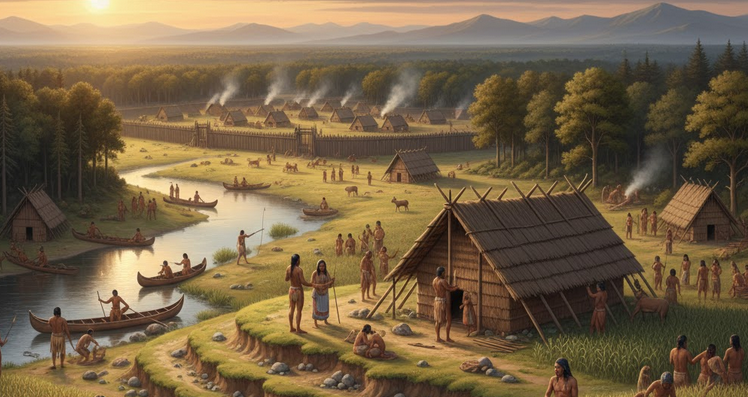
MARYLAND - While "Maryland" was named to honor Queen Henrietta Maria of England, the land is defined by the massive estuary at its heart. The name Chesapeake is derived from the Algonquian word Chesepiooc, meaning "Great Shellfish Bay" or "Village at a Big River." Long before the colonial era, the region was a network of powerful chiefdoms and trading nations, including the Piscataway, Nanticoke, Susquehannock, and Pocomoke.
To these nations, the land was not a series of counties, but a bountiful collection of "points," necks, and river inlets that provided an endless harvest of oysters, crabs, and fish.
A Confluence of Tidewater and Piedmont
Maryland’s geography—the Coastal Plain, the Piedmont, and the Appalachian Mountains—supported diverse Indigenous cultures:
- The Piscataway (Conoy): As the most populous and powerful nation in southern Maryland, the Piscataway (meaning "The People Where the Waters Blend") controlled the northern banks of the Potomac. Their capital, Moyaone, was a major political and spiritual center.
- The Nanticoke (Nentego): Inhabiting the Eastern Shore, their name translates to "People of the Tidewater" or "Those Who Fish in the Tidewaters." They were renowned for their knowledge of the marshes and their skill in maritime trade.
- The Susquehannock: A formidable Iroquoian-speaking nation from the north, they controlled the Susquehanna River valley. They were known as "The People of the Muddy River" and were dominant players in the early fur trade.
- The Pocomoke and Accohannock: These smaller nations lived along the lower Eastern Shore, deeply integrated into the seasonal rhythms of the Atlantic coast and the Bay.
Regional and Cultural Designations
Indigenous terminology describes the very features that make Maryland unique:
- The Potomac River: Derived from the Algonquian word Patawomeck, it is often interpreted as "Place where people trade" or "River of Swans." It served as the primary highway between the inland mountains and the Chesapeake Bay.
- The Eastern Shore: To the Nanticoke and Choptank, the low-lying peninsula was a world of "meandering rivers" and "salt marshes," defined by the ebb and flow of the tide.
- The Patuxent: This river bears a name meaning "At the Little Falls" or "River of the Little Falls," marking the transition from the tidewater to the hills.
Significant Indigenous Place Names
The map of Maryland is a linguistic map of the Algonquian and Iroquoian languages. Potomac and Chesapeake are the most famous, but the influence is everywhere. Wicomico means "Place where houses are built" or "Pleasant dwelling place."
The city of Salisbury sits near the Wicomico River, while Towson and Baltimore are built on lands traditionally used by the Susquehannock and Piscataway. Assateague means "Across the marsh," and Chincoteague means "Beautiful land across the water." Patapsco, the river that forms Baltimore's harbor, translates to "Backwater" or "Tidewater covered with froth." Even Accokeek and Catoctin (Place of many deer) preserve the descriptive nature of the original languages.
A Living Sovereign Presence
Today, the Piscataway Conoy Tribe, the Piscataway Indian Nation, and the Nanticoke Historic Indian Tribe are state-recognized nations that continue to advocate for the protection of the Chesapeake Bay and their ancestral burial grounds. They remain active in southern Maryland and the Eastern Shore, preserving the traditions of "The People of the Tidewater."
By recognizing the legacy of Chesepiooc and the "People Where the Waters Blend," we acknowledge a history of river-borne trade and maritime mastery that has defined the Maryland landscape for over 10,000 years.
Would you like to continue moving through the Mid-Atlantic or perhaps head toward the Northeast?